
The Supreme Court
- Home
- Philippines
- Judiciary
- Description of Courts
- The Supreme Court
The Supreme Court
The Supreme Court of the Philippines has both original and appellate jurisdiction. It exercises original jurisdiction (cases are directly filed with the Supreme Court in the first instance without passing through any of the lower courts) over cases affecting ambassadors, other public ministers and consuls, and over petitions for certiorari, prohibition, mandamus, quo warranto, and habeas corpus. (Article VIII, Section 5(1)). It also has original jurisdiction over writs of amparo, habeas data and the environmental writ of kalikasan. It exercises appellate jurisdiction to review, revise, reverse, modify, or affirm final judgments, and orders of the lower courts in:
- All cases in which the constitutionality or validity of any treaty, international or executive agreement, law, presidential decree, proclamation, order, instruction, ordinance, or regulation is in question.
- All cases involving the legality of any tax, impost, assessment, or toll, or any penalty imposed in relation thereto.
- All cases in which the jurisdiction of any lower court is in issue.
- All criminal cases in which the penalty imposed is reclusion perpetua or higher.
- All cases in which only an error or question of law is involved.
The Supreme Court has administrative supervision over all courts and court personnel (Article VIII, Section 6). It exercises this power through the Office of the Court Administrator.
Composition of the Supreme Court
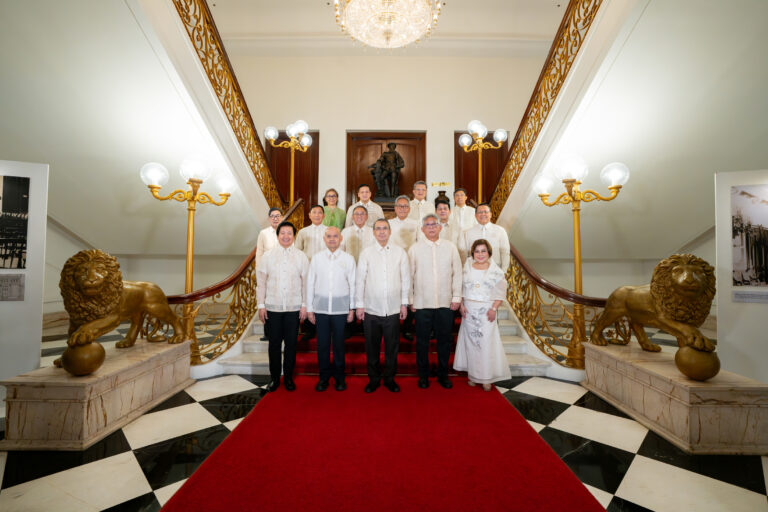
Led by Chief Justice Alexander G. Gesmundo (front row, center), the Supreme Court convened its first regular En Banc session of 2026 on January 14 at Ayuntamiento de Manila in Intramuros. The historic building served as the Court’s principal office before the Second World War.
With the Chief Justice are: (first row, from left) SC Associate Justice Ramon Paul L. Hernando, Senior Associate Justice Marvic M.V.F. Leonen, SC Associate Justices Alfredo Benjamin S. Caguioa, Amy C. Lazaro-Javier, (second row, from left) Jhosep Y. Lopez, Samuel H. Gaerlan, Henri Jean Paul B. Inting, Rodil V. Zalameda, Ricardo R. Rosario, Japar B. Dimaampao, (third row, from left) Maria Filomena D. Singh, Jose Midas P. Marquez, Antonio T. Kho, Jr., and Raul B. Villanueva.
Photo by Supreme Court Public Information Office
The Supreme Court shall be composed of a Chief Justice and fourteen Associate Justices. It may sit En Banc or, in its discretion, in divisions of three, five, or seven members (Article VIII, Section 4). Its members shall be appointed by the President from a list of at least three nominees prepared by the Judicial and Bar Council for every vacancy, without need of confirmation by the Commission on Appointments (Article VIII, Section 9).
Members of the Supreme Court are required to have proven competence, integrity, probity and independence; they must be natural-born citizens of the Philippines, at least forty years old, with at least fifteen years of experience as a judge of a lower court or law practice in the country (Article VIII, Section 7). Justices shall hold office during good behavior until they reach the age of seventy years, or become incapacitated to discharge the duties of office (Article VIII, Section 11).
Rule-Making Powers
The Supreme Court has the exclusive power to promulgate rules concerning the protection and enforcement of constitutional rights, pleading, practice, and procedure in all courts, the admission to the practice of law, the integrated bar, and legal assistance to the underprivileged. Any such rules shall provide a simplified and inexpensive procedure for the speedy disposition of cases, shall be uniform for all courts of the same grade, and shall not diminish, increase, or modify substantive rights. Rules of procedure of special courts and quasi-judicial bodies shall remain effective unless disapproved by the Supreme Court (Article VIII, Section 5(5)).
Website: https://sc.judiciary.gov.ph